
内皮细胞对PIK 3 CA突变的依赖情境响应
内皮细胞对PIK3CA突变的依赖情境响应
作者: 小柯机器人 发布时间:2026/11/26 12:56:10
本期文章:《自然》:Online/在线发表
Josep Carreras白血病研究所Graupera, Mariona课题组取得一项新突破。他们提出了内皮细胞对PIK3CA突变的环境依赖性反应。相关论文发表在2026年11月25日出版的《自然》杂志上。
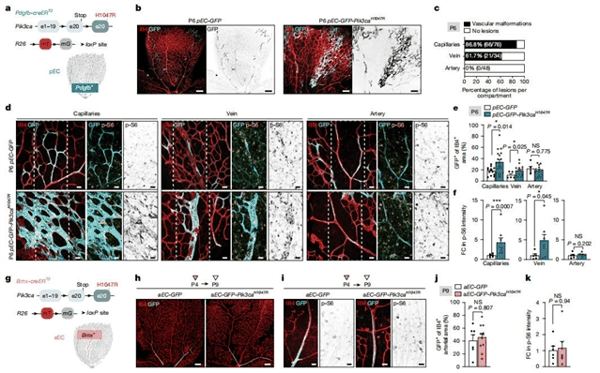
通过遗传谱系追踪,该研究团队发现PIK3CAH1047R的内皮表达驱动毛细血管内皮细胞和静脉内皮细胞的克隆扩增,而成熟的动脉内皮细胞对病理性PI3K激活是难以抑制的。动脉前体中PIK3CAH1047R的表达破坏了动脉分化,促进了静脉特征的获得,这为PIK3CA基因扰动后动脉病变较少提供了机制解释。从机制上讲,这些作用是由PI3K信号的两个互补下游分支介导的:增殖增加,驱动血管过度生长,以及上调静脉特异性转录因子NR2F2(也称为COUP-TFII),抑制动脉分化。总之,他们的发现揭示了对PIK3CAH1047R的致病反应是由内皮分化状态和命运轨迹决定的,并证明了动脉内皮本质上对致癌PI3K信号传导具有抗性。因此,动脉不受PIK3CA突变的影响,这解释了在PIK3CA驱动的疾病中动脉畸形的罕见性。
据悉,PIK3CA的癌症相关突变是先天性过度生长疾病的基础,这种疾病经常涉及血管。在受影响的组织中,内皮细胞通常表现出异常扩张,导致血管畸形3。值得注意的是,这些病变主要发生在静脉和毛细血管,而动脉基本上没有,原因尚不清楚。
附:英文原文
Title: Context-dependent response of endothelial cells to PIK3CA mutation
Author: Sabata, Helena, Roca-Coll, Ariadna, Dengra, Jose A., Martinez-Larrinaga, Ane, Andrade, Jorge, Castillo-Agea, Elena, Gouveia, Leonor, Garrido-Cruz, Maria, Collado-Remacha, Alberto, gua, Frederico, Castillo, Sandra D., Tisch, Nathalie, De Andrs-Laguillo, Macarena, Payne, Sophie, Llena, Judith, Nornes, Svanhild, Villacampa, Pilar, Szumska, Dorota, Grosso, Ana Rita, Yaniv, Karina, Vanhaesebroeck, Bart, Alcolea, Mara P., De Val, Sarah, Lopez-Fernandez, Susana, De Bock, Katrien, Baselga, Eulalia, Benedito, Rui, Potente, Michael, Angulo-Urarte, Ana, Graupera, Mariona
Issue&Volume: 2026-11-25
Abstract: Cancer-associated mutations in PIK3CA underlie congenital overgrowth disorders that frequently involve the vasculature1,2. Among the affected tissues, the endothelium commonly exhibits aberrant expansion, leading to vascular malformations3. Notably, these lesions arise predominantly in veins and capillaries, whereas arteries are largely spared, for reasons that remain unclear. Here, using genetic lineage tracing, we show that endothelial expression of PIK3CAH1047R drives profound clonal expansion of capillary and venous endothelial cells, whereas mature arterial endothelial cells are refractory to pathological PI3K activation. Expression of PIK3CAH1047R in arterial precursors disrupts arterial differentiation and promotes the acquisition of venous features, providing a mechanistic explanation for the paucity of arterial lesions after PIK3CA genetic perturbation. Mechanistically, these effects are mediated by two complementary downstream branches of PI3K signalling: increased proliferation, which drives vascular overgrowth, and upregulation of the venous-specifying transcription factor NR2F2 (also known as COUP-TFII), which suppresses arterial differentiation. Together, our findings reveal that pathogenic responses to PIK3CAH1047R are dictated by endothelial differentiation state and fate trajectory, and demonstrate that arterial endothelium is intrinsically resistant to oncogenic PI3K signalling. Arteries are therefore shielded from PIK3CA mutations, explaining the rarity of arterial malformations in PIK3CA-driven disease.
DOI: 10.1038/s41586-026-11318-5
Source: https://www.nature.com/articles/s41586-026-11318-5
主题:动脉|PIK3CA|血管|内皮细胞对PIK3CA突变