
栖息于海洋内部的原核浮游生物单细胞分辨基因组图谱
栖息于海洋内部的原核浮游生物单细胞分辨基因组图谱
作者: 小柯机器人 发布时间:2026/9/21 8:29:02
本期文章:《细胞》:Online/在线发表
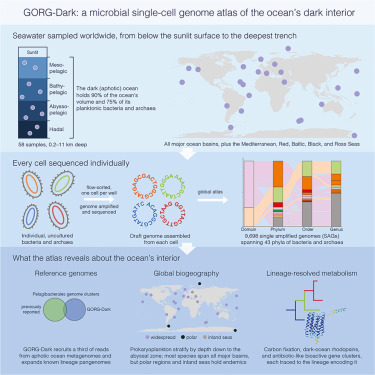
近日,美国毕格罗海洋科学实验室教授Ramunas Stepanauskas及其研究组提出了居住在海洋内部的原核浮游生物的单细胞解析基因组图谱。这一研究成果发表在近日出版的国际学术期刊《细胞》上。
海洋的无光层内部容纳了四分之三的浮游细菌和古菌(原核浮游生物),其组成、生态学和生物技术潜力仍鲜为人知。为解决这一知识空白,研究人员创建了全球海洋参考基因组(GORG)-Dark,这是一个包含9,698个基因组的数据库,来自在海洋透光层以下的广泛深度、地理位置和环境条件下非选择性采样的单个原核浮游生物细胞。生物地理学分析揭示了原核浮游生物的垂直分层延伸至深渊深度、Pelagibacterales的颗粒附着谱系的存在,以及波罗的海和黑海中此前被忽视的Patescibacteria和Nanoarchaeota的丰度。研究人员在遍及无光层海洋的原核浮游生物谱系中,鉴定出化能无机自养的编码潜力、药理学相关的次级代谢,以及一种独特类型的蛋白视紫红质。这项研究对栖息于广阔海洋内部的微生物的组成和编码潜力提供了定量的全球评估,并为微生物海洋学的网络基础设施贡献了一个广泛的、单细胞分辨的数据集。
附:英文原文
Title: Single-cell-resolved genome atlas of prokaryoplankton inhabiting the ocean’s interior
Author: Tianyi Chang, Maria G. Pachiadaki, Gregory S. Gavelis, Nicole J. Poulton, Brian Thompson, Corianna Mascena, Keir Macartney, Julia M. Brown, James J. La Clair, Alaina R. Weinheimer, Taichi Yokokawa, Paula Ruiz-Fernández, Julia Anstett, Paul M. Berube, Steven J. Biller, Beth N. Orcutt, Federico Baltar, Michael D. Burkart, Steven J. Hallam, Klaus Jürgens, Osvaldo Ulloa, Takuro Nunoura, Eva Sintes, Gerhard J. Herndl, Ramunas Stepanauskas
Issue&Volume:
Abstract: The ocean’s aphotic interior harbors three-quarters of planktonic bacteria and archaea (prokaryoplankton), whose composition, ecology, and biotechnological potential remain poorly constrained. To address this knowledge gap, we created Global Oceans Reference Genomes (GORG)-Dark, a dataset of 9,698 genomes from individual prokaryoplankton cells sampled unselectively across a broad range of depths, geographic locations, and environmental conditions below the ocean’s photic surface. Biogeographic analyses revealed prokaryoplankton vertical stratification extending to abyssal depths, the presence of particle-attached lineages of Pelagibacterales, and the previously overlooked abundance of Patescibacteria and Nanoarchaeota in the Baltic and Black Seas. We identified coding potential for chemolithoautotrophy, pharmacologically relevant secondary metabolisms, and a distinct type of proteorhodopsins in prokaryoplankton lineages prevalent throughout the aphotic ocean. This study offers a quantitative, global assessment of the composition and coding potential of microorganisms inhabiting the vast ocean’s interior and contributes an extensive, single-cell-resolved dataset to microbial oceanography’s cyberinfrastructure.
DOI: 10.1016/j.cell.2026.08.036
Source: https://www.cell.com/cell/abstract/S0092-8674(26)01009-3