
稀有k-mer揭示人类多样性与癌症易位背后的着丝粒单倍群
稀有k-mer揭示人类多样性与癌症易位背后的着丝粒单倍群
作者: 小柯机器人 发布时间:2026/10/21 21:39:21
本期文章:《细胞》:Online/在线发表
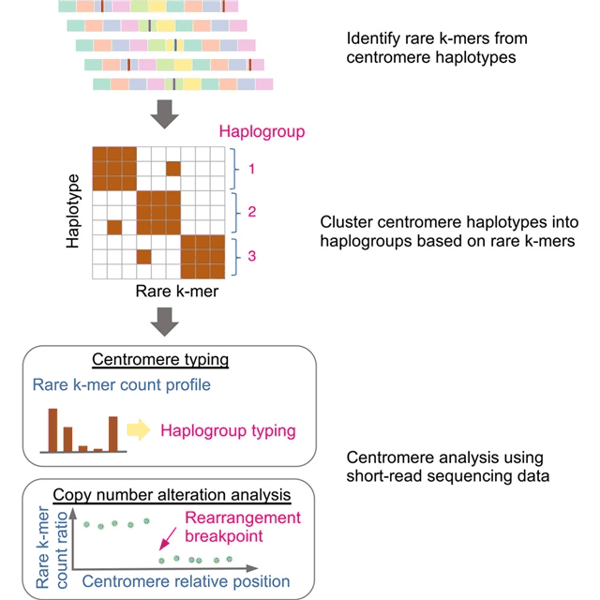
日本国立癌症中心研究所Yuichi Shiraishi等科学家在《细胞》发表研究,利用着丝粒区域稀有k-mer揭示人类多样性与癌症易位背后的着丝粒单倍群。
人类着丝粒高度可变,但仍是基因组中表征最少的区域之一,因为其重复结构阻碍了对群体多样性和疾病相关性的常规分析。在此,研究人员表明,着丝粒区域的稀有k-mer能够捕获谱系特异性变异,定义具有不同结构特征的离散单倍群。他们开发了ascairn,用于从短读长全基因组测序数据中推断这些单倍群。将该框架应用于超过3,300个基因组,揭示了着丝粒单倍群广泛的全球多样性以及群体历史的特征。通过分析142例具有1p/19q共缺失的少突胶质细胞瘤病例的短读长全基因组测序数据,研究人员将断点定位到1号和19号染色体的着丝粒区域,揭示了其与动粒附着位点的明确位置关系,以及着丝粒单倍型结构与重排易感性之间的联系。因此,稀有k-mer使着丝粒能够进行群体规模分析,将着丝粒结构多样性与人类演化历史和疾病相关基因组不稳定性联系起来。
附:英文原文
Title: Rare k-mers reveal centromere haplogroups underlying human diversity and cancer translocations
Author: Yuichi Shiraishi, Yotaro Ochi, Masahiro Sugawa, Yoshitaka Sakamoto, Keisuke Kimura, Taro Tsujimura, Ai Okada, Rurika Okuda, Shinichi Namba, Tetsuya Hori, Yoshihisa Kobayashi, Tsubasa Miyauchi, Raúl N. Mateos, Hajime Suzuki, Kenichi Chiba, Yu Ito, Wataru Nakamura, Fumiharu Ohka, Kazuya Motomura, Takuya Yamamoto, Yosuke Kawai, Yukinori Okada, Hiromichi Suzuki, Tatsuo Fukagawa, Motohiro Kato, Ryuta Saito, Erik Garrison, Glennis A. Logsdon, Seishi Ogawa
Issue&Volume: 2026-10-13
Abstract: Human centromeres are highly variable but remain among the least characterized regions of the genome because their repetitive structure has hindered conventional analysis of population diversity and disease relevance. Here, we show that rare k-mers in centromeric regions capture lineage-specific variation, defining discrete haplogroups with distinct structural features. We developed ascairn to infer these haplogroups from short-read whole-genome sequencing (WGS) data. Applying this framework to >3,300 genomes reveals extensive global diversity in centromere haplogroups and signatures of population history. Analyzing short-read WGS data from 142 oligodendroglioma cases with 1p/19q co-deletion, we mapped breakpoints to the centromere regions of chromosomes 1 and 19, revealing a clear positional relationship to kinetochore attachment sites and a link between centromere haplotype structure and rearrangement susceptibility. Rare k-mers thus open centromeres to population-scale analysis, linking centromere structural diversity to human evolutionary history and disease-associated genomic instability.
DOI: 10.1016/j.cell.2026.08.053
Source: https://www.cell.com/cell/abstract/S0092-8674(26)01064-0