
痘病毒门静脉复合体的原位结构
痘病毒门静脉复合体的原位结构
作者: 小柯机器人 发布时间:2026/7/30 17:41:34
本期文章:《自然》:Online/在线发表
英国弗朗西斯克里克研究所Peter B. Rosenthal研究组宣布他们的研究开发出了痘病毒门静脉复合体的原位结构。该项研究成果发表在2026年7月29日出版的《自然》上。
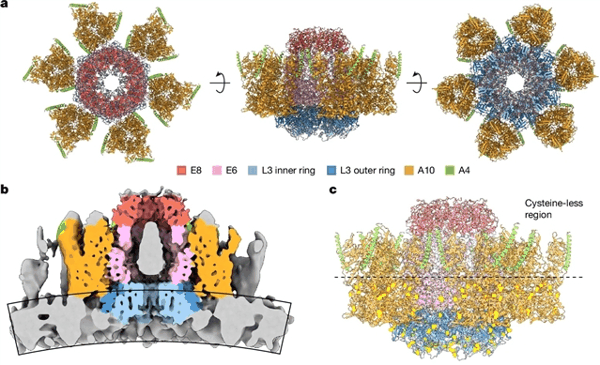
在这里,该课题组人员将低温电子断层扫描与亚层析成像平均和结构预测相结合,以确定牛痘病毒(典型的痘病毒)的门脉复合物(横跨核心壁的孔)的结构和组成。六聚体复合体由E8, E6和L3蛋白组成,这些蛋白在痘病毒中是保守的,并且在感染建立期间对mRNA释放至关重要。E6也是病毒组装所必需的,它形成了入口的中心腔室,并与周围的核心壁相互作用。E8的六聚体附着在E6的外侧。L3是TRIM5α介导的限制的靶标,以二聚体的六聚体结合在内侧。
此外,基因组从核心12释放所需的病毒解旋酶D5在感染期间通过对接到门静脉复合体的外部E8边缘与细胞质核心结合。。课题组研究人员提出,门脉复合体代表了一个有吸引力的目标,为发展抗痘病毒治疗。
据介绍,痘病毒主题是一个大型、复杂的双链DNA病毒主题家族,包括人类病原体,如天花(天花的原体)和猴痘。最近暴发的猴痘疫情强调需要更好地了解痘病毒生物学。痘病毒组装是一个保守的过程,涉及成熟病毒膜内形成双凹核。
附:英文原文
Title: In situ structure of the poxvirus portal complex
Author: Calcraft, Thomas, Hernandez-Gonzalez, Miguel, Way, Michael, Rosenthal, Peter B.
Issue&Volume: 2026-07-29
Abstract: Poxviruses are a family of large, complex double-stranded DNA viruses that includes human pathogens such as variola—the cause of smallpox—and monkeypox. Recent outbreaks of mpox underscore the need for a better understanding of poxvirus biology1,2. Poxvirus assembly is a conserved process that involves the formation of a biconcave core inside the membrane of the maturing virus3,4. Here we use cryo-electron tomography combined with subtomogram averaging and structure prediction to determine the structure and composition of the portal complex—a pore that spans the core wall—in vaccinia virus, the prototypical poxvirus. The hexameric complex consists of the E8, E6 and L3 proteins, which are conserved across poxviruses and essential for mRNA release during the establishment of infection5,6,7. E6, which is also required for virus assembly8,9,10, forms the central chamber of the portal and interacts with the surrounding core wall. A hexamer of E8 attaches to the exterior side of E6. L3, a target of TRIM5α-mediated restriction11, binds as a hexamer of dimers to the interior side. Furthermore, the viral helicase D5, which is required for genome release from cores12, associates with cytoplasmic cores during infection by docking onto the exterior E8 rim of the portal complex. We propose that the portal complex represents an attractive target for the development of anti-poxvirus therapeutics.
DOI: 10.1038/s41586-026-10856-2
Source: https://www.nature.com/articles/s41586-026-10856-2