
机械负荷抑制小鼠和人类心脏肿瘤的生长
机械负荷抑制小鼠和人类心脏肿瘤的生长
作者: 小柯机器人 发布时间:2026/4/24 15:13:44
本期文章:《科学》:Volume 392 Issue 6796
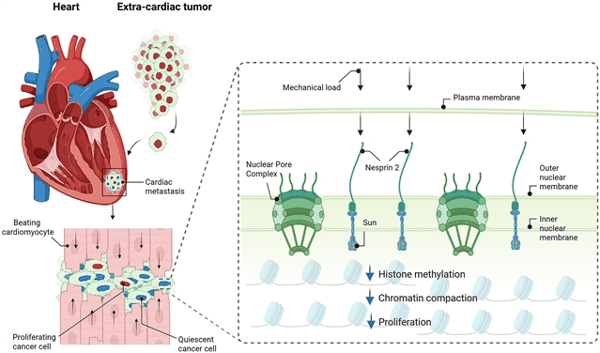
机械负荷抑制小鼠和人类心脏肿瘤的生长,这一成果由意大利的里雅斯特大学 Serena Zacchigna小组经过不懈努力而取得。这一研究成果发表在2026年4月23日出版的国际学术期刊《科学》上。
在这项工作中,研究人员研究了机械负荷的作用,并在体内癌症模型和离体工程心脏组织中进行了主题研究,以表明机械负荷可减少心肌中癌细胞的增殖。人类心脏转移瘤的空间转录组学显示组蛋白甲基化和染色质压实减少。这些变化影响增殖相关位点的染色质可及性,Nesprin2被认为是一个关键的机械传感器。他们的研究结果揭示了机械力是如何保护心脏免受癌症侵害的,并提出了基于机械刺激的癌症治疗的潜在策略。
据介绍,心脏很少患癌症,同时,由于心肌细胞在出生后停止增殖,它缺乏再生能力。这表明限制心脏再生的机制也可以预防癌症。
附:英文原文
Title: Mechanical load inhibits cancer growth in mouse and human hearts
Author: Giulio Ciucci, Daniela Lorizio, Nicoletta Bartoloni, Mauricio Budini, Andrea Colliva, Simone Vodret, Anh-Vu Nguyen, Lorenzo Ciacci, Bernhard Texler, Benno Cardini, Rupert Oberhuber, Sofia Bindelli, Ilaria Luciana Carlotta Del Giudice, Roman Vuerich, Francesco Riccitelli, Elena Zago, Henrik Nicolay Finsberg, Mattia Chiesa, Gianluca Lorenzo Perrucci, Rossana Bussani, Furio Silvestri, Manuel Maglione, Gaetano Ivan Dellino, Gianfranco Sinagra, Mauro Giacca, Thomas Eschenhagen, Paolo Golino, Giulio Pompilio, Pier Giuseppe Pelicci, Laura Andolfi, Maurizio Pinamonti, Matteo Dal Ferro, Samuel Wall, Francesco S. Loffredo, Serena Zacchigna
Issue&Volume: 2026-04-23
Abstract: The heart rarely develops cancer, and, at the same time, it lacks regenerative capacity, as cardiomyocytes stop proliferating after birth. This suggests that mechanisms limiting cardiac regeneration may also protect against cancer. In this work, we investigated the role of mechanical load and used in vivo cancer models and ex vivo engineered heart tissues to show that mechanical load reduces cancer cell proliferation in the myocardium. Spatial transcriptomics of human cardiac metastases revealed decreased histone methylation and chromatin compaction. These changes affect chromatin accessibility at proliferation-related loci, with Nesprin-2 identified as a key mechanosensor. Our results uncover how mechanical forces protect the heart from cancer and suggest potential strategies for cancer therapy based on mechanical stimulation.
DOI: ads9412
Source: https://www.science.org/doi/10.1126/science.ads9412