
在100万人中,FNIP 1变异与良好的代谢有关
在100万人中,FNIP1变异与良好的代谢有关
作者: 小柯机器人 发布时间:2026/8/6 15:31:30
本期文章:《自然》:Online/在线发表
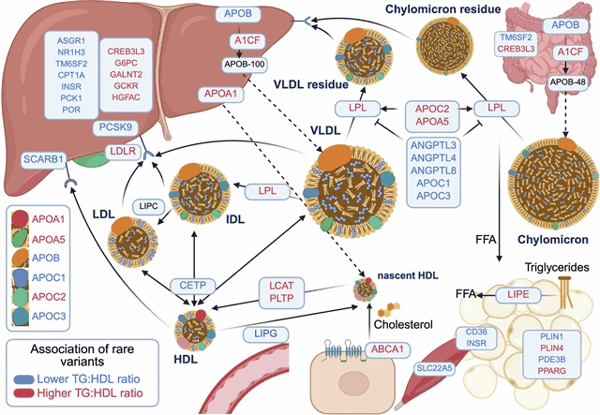
美国再生基因中心Luca A. Lotta团队的一项最新研究发现在100万人中,FNIP1变异与良好的代谢有关。相关论文于2026年8月5日发表在《自然》杂志上。
为了研究能量代谢的遗传基础,该研究组对来自美国、欧洲和亚洲的1,032,116人进行了外显子组测序分析,并估计了罕见的蛋白质编码变异与甘油三酯与高密度脂蛋白胆固醇(TG:HDL)的比率之间的关联。甘油三酯与高密度脂蛋白胆固醇(TG:HDL)是一种能量状态生物标志物,该研究组将其与多种心脏代谢风险因素和疾病联系起来。
研究团队鉴定出59个独立的基因(P < 1.04 × 10 -7 )富含肝脏和脂肪表达的能量平衡、储存和代谢的主要调节因子;这些基因中有23个(39%)编码已批准或处于临床阶段的药物靶点。编码能量消耗和线粒体代谢抑制因子的FNIP1(等位基因频率为0.01%)中超罕见的蛋白质截断变异与较低的TG:HDL比率、较低的肝脏脂肪、较低的血糖、有利的脂肪分布以及约60%的心脏代谢疾病几率降低相关。在原代人肝细胞中敲低FNIP1可诱导脂质分解和溶酶体基因表达,而在高脂饮食小鼠中,敲低FNIP1与其旁系物FNIP2或敲低其相互作用物Flcn的肝脏联合敲低FNIP1可防止体重增加、减少肝脏脂肪并增强胰岛素敏感性。他们的研究暗示了FNIP1通路在人类能量代谢中,并强调了其抑制作为心脏代谢疾病的潜在治疗策略。
据悉,能量代谢的改变是心脏代谢疾病的共同驱动因素,而心脏代谢疾病是全球死亡的主要原因。能量代谢因人而异,部分可遗传。
附:英文原文
Title: FNIP1 variants are associated with favourable metabolism in 1 million humans
Author: Hindy, George, Adam, Rene C., Sosina, Olukayode, Pryce, Dwaine, Blair, David, Herman, Joseph, Lee, Joseph, Dornbos, Peter, Mayerhofer, Ernst, Gilly, Arthur, Hunt, Charleen, Geraghty, Benjamin, Landheer, Karl, Ganel, Liron, Baldassari, Antoine, Zhang, Chuanyi, Mintah, Ivory, Sun, Daphne, Coppola, Angel, Brown, Kyle, Nguyen, Tram, Xia, Xin, Rader, Daniel J., Melander, Olle, Still, Christopher D., Berumen, Jaime, Kuri-Morales, Pablo, Alegre-Daz, Jesus, Torres, Jason M., Emberson, Jonathan R., Collins, Rory, Tapia-Conyer, Roberto, Balasubramanian, Suganthi, Jones, Marcus B., LeBlanc, Michelle G., Murphy, Andrew J., Kyratsous, Christos A., Overton, John D., Reid, Jeffrey G., Abecasis, Goncalo R., Marchini, Jonathan, Willer, Cristen, Yancopoulos, George D., Sleeman, Mark W., Bovijn, Jonas, Locke, Adam, Baras, Aris, Verweij, Niek, Gusarova, Viktoria, Lotta, Luca A.
Issue&Volume: 2026-08-05
Abstract: Altered energy metabolism is a shared driver across cardiometabolic diseases—the leading cause of death globally1. Energy metabolism varies between individuals and is partly heritable2,3,4,5,6,7,8,9. Here, to investigate the genetic basis of energy metabolism, we perform an exome-sequencing analysis of 1,032,116 people from America, Europe and Asia, and estimate associations between rare protein-coding variants and the ratio of triglyceride to high-density-lipoprotein cholesterol (TG:HDL)—an energy-state biomarker that we associate with diverse cardiometabolic risk factors and diseases. We identify 59 independent genes (P<1.04×10⁷) that are enriched for liver- and adipose-expressed master regulators of energy balance, storage and metabolism; 23 (39%) of these genes encode approved or clinical-stage drug targets. Ultra-rare protein-truncating variants in FNIP1 (allele frequency, 0.01%), which encodes a suppressor of energy expenditure and mitochondrial metabolism, are associated with a lower TG:HDL ratio, lower liver fat, lower glycaemia, favourable fat distribution and around 60% lower odds of cardiometabolic disease. FNIP1 knockdown in primary human hepatocytes induces lipid breakdown and lysosomal gene expression, while combined hepatic knockdown of Fnip1 with its paralogue Fnip2 or knockdown of its interactor Flcn protect against weight gain, reduce liver fat and enhance insulin sensitivity in mice fed a high-fat diet. Our study implicates the FNIP1 pathway in human energy metabolism and highlights its inhibition as a potential therapeutic strategy in cardiometabolic disease.
DOI: 10.1038/s41586-026-10864-2
Source: https://www.nature.com/articles/s41586-026-10864-2